Saturday, April 15, 2023

Week 16: Should Be A Movie


It could have been a movie script...the opening shots of a war...the call for men to fight...tearful goodbyes as they left...death, pain, and suffering...joyful reunions and heartbreaks over losses.             In this script, the cast of characters consisted of my Scott ancestors.

When news of the attack on Fort Sumter, South Carolina, on 12 Apr 1861, reached the state of Indiana its citizens immediately responded.  Two mass meetings were held on 13 Apr in the state capitol where the state's decision was that Indiana would remain in the Union.  The governor issued a call for volunteer soldiers to answer the state's quota requested by President Abraham Lincoln and Indiana became the first western state to mobilize for the Civil War.  Within a week nearly 12,000 Hoosier men had volunteered to join the fight to suppress the rebellion.  

Among the young men who volunteered during the war years were six brothers, sons of Caleb and Mary Ivins Scott.  The sons, in birth order were:

        Samuel               b. 28 Jan 1832      my 2x great-grandfather

        William              b. 14 Feb 1836     my 2nd great-granduncle

        Caleb Shreve     b. 16 Jun 1838      my 2nd great-granduncle

        Isaac                   b.  23 Sep 1840     my 2nd great-granduncle

        Joseph                b.  29 May 1842    my 2nd great-granduncle

        Joshua                b.  6 Jul 1845         my 2nd great-granduncle

First to leave home to serve were Caleb Shreve (23 yrs.) and Isaac (21 yrs.) on 24 Sep 1861.  Both joined the 30th Indiana Infantry Regiment, Company B.  

Two months later on 14 Nov 1861 Joseph (19 yrs.) joined the 46th Indiana Infantry Regiment, Company F.  

The following summer William (26 yrs.) enlisted on 9 Aug 1862 in the 12th Indiana Infantry Regiment, Company I. 

Just two weeks later on 22 Aug 1862 Samuel (30 yrs.) left to join the 30th Indiana Infantry Regiment, Company B, where Caleb and Isaac were already serving.

Last to leave was Joshua (18 yrs.) who left home on 16 Mar 1864 to serve in the 74th Indiana Infantry Regiment, Company A.

I have to imagine that every time one of their sons left Caleb and Mary's hearts broke a little more.  Undoubtedly they were proud that six of their eight sons volunteered but it must have been so hard not  knowing if they'd ever see those sons again.  The Scott family was more fortunate than many other families.  Of the six who left, five returned home to Indiana.  Only Caleb Shreve was lost.

Caleb was captured at Chickamauga, the second most deadly battle of the war, on 19 Sep 1863 and sent to the infamous Confederate prison camp at Andersonville, GA.  The camp at Andersonville consisted of open fields surrounded by wooden stockades where the captured soldiers suffered from over-crowding, poor sanitation, disease, exposure, and inadequate food. Of the 45,000 prisoners at Andersonville, nearly 13,000 died.

On 12 Dec 1863 Caleb was admitted to a hospital at Danville, VA, where he died a few weeks later from the Variola virus (smallpox).  Caleb is buried in Danville in the Danville National Cemetery, Section H, Grave #699.  I've often wondered if any of Caleb's immediate family were ever able to visit his grave, saw a photograph of his headstone, or received any of his possessions.

Rest in peace, Uncle Caleb.


Thursday, April 6, 2023

Week 15: Solitude


Minnie Lee Casto

My great-grandma Minnie Lee Casto Williams was a woman who never had many chances to experience solitude.  Her birth date sometimes appears as 1879 and other times as 1881 so I've been thinking about which year is most likely.  I know that Minnie's brother William Harvey Casto was born in 1879 and her sister Martha Matilda Casto was born in 1884, leaving a five-year gap in her mother's childbearing years.  So unless Minnie and William were twins--and there are no family stories about that--I suspect Minnie was born in 1881.  In every census her given age coincides with a birth year of 1881, yet her obituary and gravestone both say she was born in 1879.  Since Minnie wouldn't have had a say in the obituary or the engraving on her gravestone, my guess is that her family members got it wrong.  Not many women would add two extra years to their age.

Minnie and her five siblings were born over a fourteen year period so the Casto household must have been a noisy and lively place as she grew up.  First born was brother Dennis Reason (1876), then brother William Harvey (1879), Minnie (1881??), her only sister Martha Matilda (1884), brother Charles Albert (1886), and brother Benjamin Harrison (1890).  For Minnie, opportunities for solitude must have been limited between her farm chores, household chores, siblings, and school work.  School ended for her after 8th grade, which leaves me to wonder what Minnie's life was like for the next few years.  If school ended when she was around fourteen years old, did she still live at home and just take on more responsibilities or did she find a job suitable for a girl her age?

On Christmas Eve of 1899 Minnie married Owen Quillon Williams in Jasper County, Indiana. For the first two years of their marriage Minnie may have had a quiet life while Owen worked as a farm laborer and she kept house.  But having children changed Minnie's life dramatically and her chances for solitude slipped away as she gave birth over and over.

In order, Minnie's babies were:

  • Russell Monroe in Nov 1901
  • Louis Linden in Feb 1903
  • Martha Viola in Mar 1904  (died at 3 months old)
  • Renolt Loyd in Jun 1905
  • Lester Eldon in Sep 1906  
  • Elsie May in Mar 1908
  • Leola Rae in Dec 1910
  • Alfreda Eliza in Aug 1912
  • Florence Kathryn in Sep 1914
  • Della Matilda in Apr 1917  and finally a little gap.....
  • Robert Quillon in Mar 1926
Were families this large commonplace in the first two decades of the twentieth century? Actually, according to most census estimates, by 1900 American women had on average 3.5 children, which was a radical change from the 19th century.  In 1800 American women had on average 7-8 children.  A  family of 10 would probably have been considered unusual at the time.

Minnie gave birth to ten babies in the space of sixteen years before "oops" baby Robert appeared nine years later when she was 45 years old.  In order to have ten babies in such a short span of time Minnie would have been constantly pregnant or nursing, with little chance to fully physically recuperate from the previous pregnancy before the next began.  Besides the physical strains that would have caused, Minnie would have had little--if any--time for quiet or solitude in the home. Her days would have been filled with taking care of children, waking up early to light the stove for the day's cooking, cleaning the house, washing mountains of clothes, mending clothes, tending to a garden, and making ends meet.  In the 1930s my mom remembers being at Grandma Minnie's house and watching her wash dishes in two large dish pans that sat on a table, singing hymns as she worked.  Despite the untold hours of work it would have taken to manage such a large family, Minnie kept her sanity and did it with grace.  


Minnie shortly before her death in 1959 from heart disease and diabetes


Monday, April 3, 2023

Week 14: Begins With a Vowel


Albert Arbuckle Bird

Albert Arbuckle Bird, my 2x great-grandfather, was born in Holmes County, Ohio, on July 1, 1840 as the seventh child of Elijah Bird and Eliza Williams Bird.  I was curious to know how the middle name of Arbuckle was chosen.  It turns out that it was the maiden name of Albert's maternal grandmother, Sarah Arbuckle (1780 - 1825).  

Like many of my ancestors, the Birds didn't make Ohio their permanent home.  The land must have looked more promising on the other side of the state line because by 1850 Census 10-year old Albert and his family had moved 250 miles north and west to Kosciusko County, Indiana.  Ten years later in the 1860 Census 20-year old Albert was unmarried and still living on the family farm there.

In 1865 when Albert was 24 years old he joined the 152nd Indiana Infantry Regiment of the Union Army as a private.  The 152nd spent the next five months in Virginia and West Virginia assigned to the Army of the Shenandoah until the regiment was mustered out.  

Back home again in Indiana Albert must have decided it was time to settle down and start a family.  The girl who caught his eye was Sarah Ann Norris, who was a month shy of her 16th birthday when the couple married on 3 July 1867.  The Luther Norris farm (Sarah's father) and the Elijah Bird farm (Albert's father) were situated a short distance apart in Monroe Township, Kosciusko County, Indiana so the couple may have met at church or at a social gathering in the township. 


On 5 Oct 1868 Albert and Sarah's first child Clarence was born.  The family must have moved soon after this because the 1870 Census shows them as residents of Monroe Township, Livingston County, Missouri.  (From one Monroe Township to another!) Albert was listed as a farmer, Sarah was keeping house, and Clarence was a year old.  The family's real estate was valued at $500 and their personal estate valued at $100.  

Luther (15 Sep 1870 - 13 Nov 1870) and James (30 Mar 1872 - 9 Jun 1872) were the next children to be born but sadly neither lived past infancy.  I haven't been able to determine whether the two boys were born in Missouri or in Indiana.  I do know that Albert and Sarah's first daughter, Mary Elluria, was born in Kosciusko County, Indiana so sometime between the 1870 Census and Mary's birth on 16 Jun 1873 the family left Missouri and headed back to Kosciusko County, Indiana.  The next children born were my great-grandfather Charles Orastus (13 Oct 1874) and Stephen Allyn (14 Dec 1876), both in Kosciusko County.  

On 24 Mar 1885 when Albert was 44 years old, 33-year old Sarah passed away from typhoid fever.  At the time of her death the children were 16, 11, 10, and 8 years old.  Surprisingly, Albert didn't remarry so he and the children must have figured out how to manage on their own after the loss of Sarah. 

Since nearly all the 1890 Census records were destroyed by fire, the fifteen years between Albert's loss of Sarah are unknown. 

In the 1900 Census 59-year old Albert was living in Lewanee County, Michigan with his daughter Mary, his son-in-law Frank Merrick, and his 5-year old granddaughter Theodora. Albert worked as a laborer in a saw mill.  

Ten years later in the 1910 Census Albert, Mary, Frank, and Theodora had moved back home to Indiana where they lived in a house on Higbee Street in the town of Milford in Van Buren Township, Kosciusko County.  Albert had retired by that time.  Scrolling through the eight pages of census enumeration for Milford I found Albert's younger brother (my great-grandfather) Charles, his wife Grace, and their six children living near my great-grandparents William and Mary Scott and their two sons.  By 1920 Charles and Grace's daughter Eva would marry William and Mary's son Angus Cleon (A.C.).  Eva and A.C. are my paternal grandparents.  

In the 1920 Census Albert remained in Milford with the Merricks.  By January 20th when the enumerator visited, Albert was 79 years old.  

On 13 Nov 1925 Albert passed away at the age of eighty-five from chronic endocarditis and prostrate problems.  He had outlived his wife, three of his sons, and all nine of his siblings.   


Sarah and Albert

Albert is buried in the Milford Cemetery.


Sunday, March 26, 2023

Week 13: Light a Candle


As I build my family trees it's such a sad moment when I find a relative who died as an infant or toddler.  I try to imagine the grief and loss that the mother must have felt.  In the years covered by my family trees women faced twenty to thirty years of constant pregnancy, childbirth, and nursing with little access to birth control.  Without the use of medical imaging, regular prenatal care, use of antimicrobial agents, and reliable blood transfusions, many babies were stillborn or died within a short time after birth.  Those who were lucky enough to survive infancy faced the hurdle of diseases before the age of vaccinations.  

The child mortality rate in the United States, for children ages five and under, was approximately 460 deaths per 1000 births in 1800.  In other words, for every thousand babies born in 1800, nearly half didn't make it to their fifth birthday.

By 1900, for every 1000 live births, 100 infants died before their first birthday. This statistic was true in the lifetime of my own grandparent.  It makes me wonder how many babies and young children faded into history and didn't make it into the documents that support my research. Here are a few who were recorded:

Mary McKibbon    1812-1812    3rd great-grandaunt

Infant daughter Foulke    1878-1878    1st cousin 2x removed

Bessie D. Foulke    1881-1881    1st cousin 2x removed

Martha Viola Williams    1904-1904 (5 months)    grandaunt

Sally Ann Hess    1815-1816 (15 months)    3rd great-grandaunt

Ezra Hess    1820-1822 (23 months)    3rd great-granduncle

Horatio Hess    1824-1824 (8 months)   3rd great-granduncle

Jacob Hess    1878-1878 (16 days)   great-granduncle

Eerie Franklin Bird    1914-1914 (2 days)    granduncle

Closest to me was my first grandson.  Even with the medical advantages now, unexplained tragedies sometimes happen.  I'll love you forever, Zach, and always wonder about the boy you would have been and the man you would have become.

Zachary Evan Malahowski     27 May 2008    grandson


Tuesday, March 21, 2023

Week 12: Membership


Mary E. Dubbs Scott

My great-grandmother Mary E. (was it Elizabeth?) Dubbs Scott was a woman who had outside interests besides her life as a wife and mother of two.  Mary was born in Union Township, Elkhart County, Indiana on 29 Jun 1868, the daughter of John and Matilda Miller Dubbs.  She was one of six children, the fourth in birth order.  The 1880 Census found the Dubbs family living in neighboring Van Buren Township, Kosciusko County near the town of Milford, where Mary would live for the rest of her life.  At twenty-four she married a Milford man named William Oldfield Scott.  Together they had two sons: my grandfather Angus Cleon Scott and my grand-uncle William Franklin Scott.

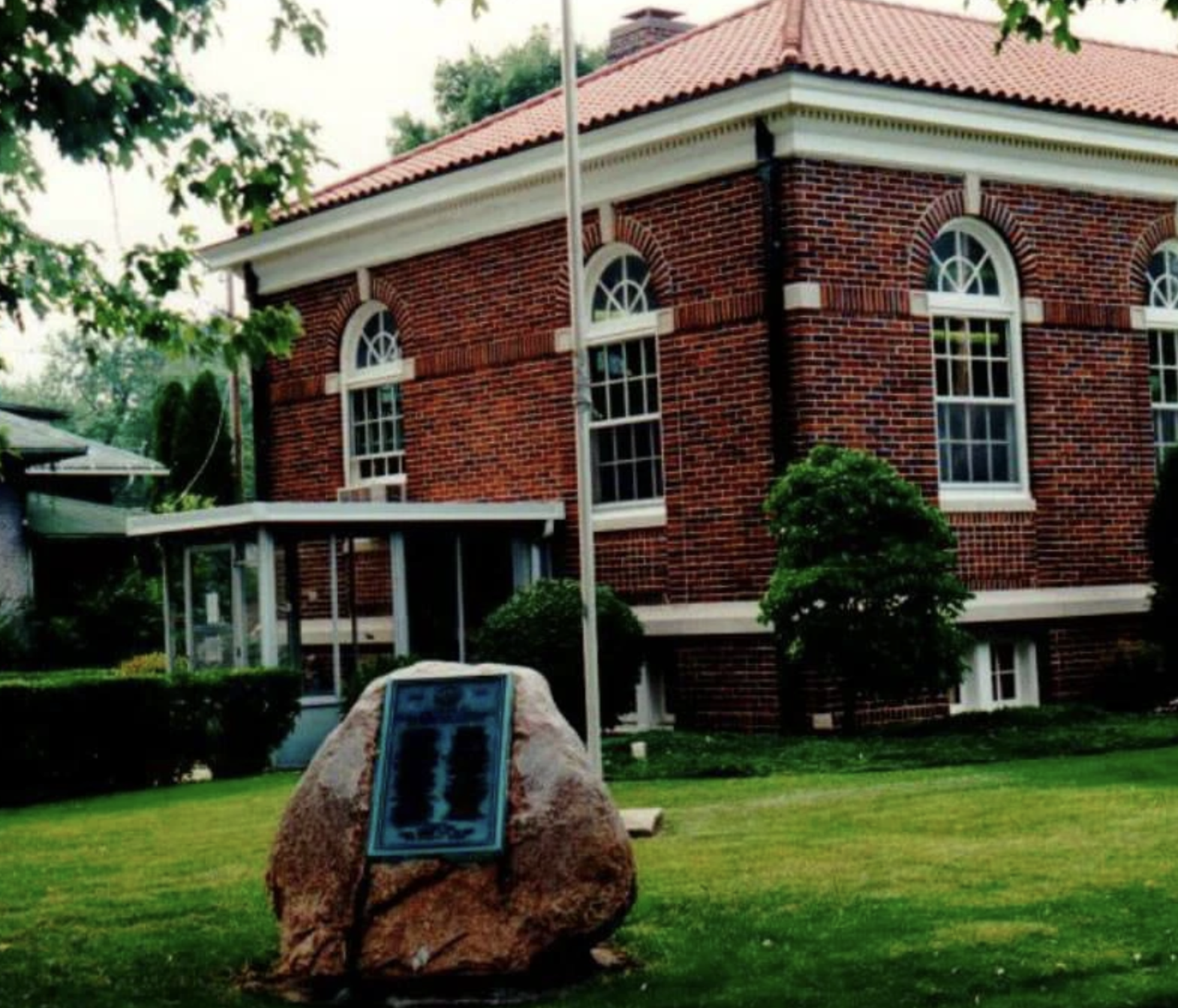
Although Mary was busy keeping house and being a mother, she found time to work in the family hardware store and to be an active member of the Grace Brethren Church's women's group and the Columbian Reading Circle.  I was excited to learn about her involvement with the Reading Circle because I enjoy being a part of two book clubs.  The Columbian Reading Circle members didn't limit themselves to monthly book discussions.  Instead, in 1907 the group spearheaded the formation of the Milford Public Library Association.  They started small in a room of the Hotel Milford with eighty books that were borrowed from the state and organized a community "book shower" to ask for book donations.  In the years following, the library grew out of several temporary homes and in 1916 the library was awarded a $10,000 grant from the Andrew Carnegie Fund.  With the help of that grant and tax funds from the town and townships, a permanent library (which still stands today) was built in 1918.  

Mary passed away from carcinoma of the stomach on 10 Oct 1929, just eighteen days before the stock market crashed.  She didn't live to see the family hardware store fail, to see her grandchildren to grow up, or to meet her great-grandchildren.  But she was loved and she played a part in bringing the gift of a library to the town of Milford.

            Mary and her church women's group.  She is third from left, looking off in the distance!


Saturday, March 11, 2023

Week 11: Lucky


Daniel William Williams was a man who was lucky--or should it be considered unlucky?--in love.  This second great-grandfather of mine was born on 25 May 1851 and lived just two months shy of ninety years.  Why was my first inclination to call him lucky in love?  It's because between the ages of eighteen and his mid-seventies Daniel was able to woo four women to be his wives (two of them were sisters).  No, he wasn't a polygamist.  Daniel was just unlucky enough to outlive three of those wives.

His first wife was a few years older than he.  In the 1870 Census Daniel, age 19, and his bride Nancy Catharine Bullard, age 22, were living with his parents in White County, Indiana.  The young couple had been married two months earlier on 24 May 1870.  Just four months after their vows Nancy gave birth to a son they named Sylvester Wesley Williams.  No record of Catherine's death or her burial has been found, but she died sometime between Sylvester's birth and 1874 since Daniel remarried that year.  Did Catherine die during childbirth, from a disease, or from an accident?  Daniel was unlucky to to be widowed at such a young age.

Before long Daniel was lucky to find a new wife.  On 13 Dec 1874 he married 19-year old Madora Almina Mikesell, my ancestor.  Madora and Daniel quickly expanded their family by adding Eliza May in 1876, Mary Belle in 1877, Owen Quillon (my ancestor) in 1878, Nancy Katherine in 1881, Clyde Monroe in 1885, and Daniel William Williams Jr. in 1886. Including Sylvester Wesley, his son with Catherine, that made seven children.

If most of the 1890 Census records hadn't been destroyed by fire it would have shown that Daniel was unlucky enough to be widowed again the previous year when Madora died on 10 Jan 1889 at the age of thirty-three. On the Find-a-Grave website there is a notation that Madora's grave is shared by an infant named Leonidas who had been born in 1887 and lived for just twenty-one days.  In the same cemetery there is a grave for a child named Leroy Williams who lived from 3 Jan 1869 to 13 Aug 1889.  He too might be Madora's child because she died just a week after this birth.  Daniel was unlucky to have been widowed for a second time.

Being a widower with seven children couldn't have been easy.  Two and a half years after Madora's passing, Daniel was lucky to find another wife, someone he had known for many years. He married Viola "Mandy" Mikesell, Madera's younger sister, on 1 Jun 1891.  When the two married, Daniel was forty years old and Mandy was half his age at just twenty.  Mandy took on the responsibility of raising the seven children from his two previous wives.  

Were Mandy and Daniel lucky enough to have children of their own?  The 1900 Census is confusing because the enumerator recorded the family members still living at home as Daniel, Mandy, Clyde (14) and Daniel Jr. (13).  But it also says that Amanda had given birth to two children who were both living.  Did the enumerator just assume that she was the biological mother of Clyde and Daniel Jr.?  The 1910 Census didn't show any children still living at home. The issue is further confused in the 1920 Census when Daniel and Amanda have a 29-year old son named Joseph Williams living with them plus 33-year old Daniel William Williams Jr.  Both are recorded as step-sons.  Daniel Jr. was Amanda's step-son but who was Joseph?  Was he a biological son who was missed on the 1900 Census?  It's a mystery. 

After thirty-five years of marriage Daniel was unlucky to be a widower again when Mandy passed away from kidney disease in 1926.  But true to form, Daniel was lucky to find a fourth wife, Georgianna Jordan.  He and Georgianna were lucky to be together until 15 Mar 1941 when Daniel died at eighty-nine. Daniel passed away in Illinois but his body was moved to Rensselaer, Indiana to share a headstone with his third wife, Mandy.  

So was Daniel a lucky man or an unlucky man?  He certainly was unlucky to have experienced so many losses in his long life but was lucky to have found the love of four women and lucky to have become a father to eight children who lived past infancy. 


Daniel, Mandy, and 8 children


For some reason, the headstone was never updated to show the last two digits of Daniel's death year.

Tuesday, March 7, 2023

Week 10: Translation


What was it like to come to the English colonies of North America in the 1700's from your native Germany, enduring a rough and possibly dangerous voyage across the Atlantic, and most likely speaking no English?  Who would translate for you?  How would you start a new life on the new continent when you couldn't communicate with most people?

That's what Casper Hess, my 6th great-grandfather, was brave enough to do.  Casper was born in Baden-Württemberg, Germany about 1715 but I don't know what year he made the journey from Germany to the Colonies.  Arrival records are spotty at this time in history and the name Hess was a common one.  The ship lists of immigrants arriving in Philadelphia are incomplete and only males over 16 years of age were recorded.  According to the Pennsylvania German Pioneers book by Strausburger and Hinks:

"Each captain wrote his list on a large, loose sheet of paper which he handed to the magistrate at Philadelphia, who incorporated the names of the signer of the oath of allegiance into the minutes of the council.  What became of the lists of the captains handed in on loose sheets of paper?  Sad to relate, most of them were lost.  Of the 324 ships arriving between 1727 and 1775 we have captain lists for only 138 ships." 

No record of a Casper Hess arriving in Philadelphia has been found.  Does it mean he arrived in another port?  Possibly.  I've seen others post a record on Ancestry.com of a Casper Hess arriving in Carolina in 1743.  But the Carolina colony was a very long distance from York, Pennsylvania where there are records of Casper living and becoming a father.  The surname of Hess is a common one in Germany and I've seen the name of Casper Hess in many time periods and places so I don't think the man who arrived in Carolina was him.

What I do know is that my ancestor Casper Hess married a woman by the name of Maria Eva (maiden name unknown) and together they had a daughter Maria Magdalena in 1745 and a son George Balser in 1747.  Unfortunately, the family didn't have long together because at some point between 1747 when George Balser was born and in 1752 when the widow Maria Eva remarried to Philip Peter, Casper died. He would have been in his 30s at the time. He died intestate (leaving no will) so his death may have been sudden or violent.  It wasn't until 1759, seven years after Maria's marriage to Philip Peter, that an estate was opened for Casper.  The inventory of his estate included some real estate, a house, some household goods, ten books,  a cow, and other items.  The personal property was said to be worth 37 pounds, eight shillings, and four pence more than the value of the real estate.

In his short time in the American colonies Casper was probably a farmer.  He married, had children, and provided for his family, then died a premature death.  What he didn't know was that his son George Balser would someday be a soldier in the American Revolution.  The town of York, Pennsylvania where Casper had lived was a hotbed of activity during the war.  In September of 1777 the Continental Congress moved the location of the colonies' central government to York and it was there where the Congress adopted the Articles of Confederation.  York was the Capital of the United States for nine months until June 27, 1778.  

I'm sure Casper would have been proud to know of his son George Balser's service to the new country.  And I'm sure he would have wondered why it took Maria so long to open his estate.

Week 52: Me, Myself, and I

  Dear future family genealogists: I’m writing this to tell you a little about myself—something to help flesh out what online documents migh...