Wednesday, September 20, 2023

Week 39: Surprise

I had an amazing surprise three years ago when I got a reply back on Ancestry.com to a message I had sent a few days earlier.  I had a DNA match to a potential 3rd-4th cousin through my 2x great-grandfather Alfred Cartwright, a man who has always been a brick wall in my family tree. I asked my DNA match if I could please have access to their private tree.  

When I heard back from my match she didn't give me access but she did send a giant file via DropBox that held a book of history on the Nelson and McKibbin families in Indiana.  Alfred Cartwright had married Mary Ann Nelson so that was an exciting find.  But when I looked closer at the picture and name of my DNA match it suddenly dawned on me that I was communicating with CYNDI INGLE, the creator of Cyndi's List!  Cyndi's List has been a popular and incredibly useful genealogy tool for more than 25 years.  The following is taken from Cyndi's "about' page on the website:

What exactly is Cyndi's List?

A categorized & cross-referenced index to genealogical resources on the Internet.

A list of links that point you to genealogical research sites online.

A free jumping-off point for you to use in your online research.

A "card catalog" to the genealogical collection in the immense library that is the Internet.

Your genealogical research portal onto the Internet.

Each month the Cyndi's List web site gets approximately 250,000 unique visitors and 970,000 pages visited with more than 31,760,000 successful page requests.

On average I add 1,500 new links, update/correct 600 links, and delete 300 non-working links each month.

There are more than 180 categories on the list, as well as individual pages for each US state, US county, Canadian province, and UK county. Cyndi's List has been a trusted genealogy research site for more than 25 years. Cyndi's List is free for everyone to use and it is meant to be your starting point when researching online. 


I was thrilled to know that Cyndi and I share 22 cM of DNA through my maternal line!  My relationship to each of the people listed here is shown under their name.  


Cyndi didn't know much about our shared ancestor Alfred either.  She kindly sent me a file from the National Archives that detailed the process that my GG Walter Cartwright went through to apply for 160 acres of land in North Dakota under the Homestead Act, just like his brother Francis had done.  

I still haven't broken through the brick walls surrounding 2x GG Alfred Cartwright but I'll keep trying.  I'd love to have a breakthrough that I could share with Cyndi to repay her kind sharing.


Monday, September 11, 2023

Weeks 37 & 38: Prosperity...and Adversity


                                                                   William Oldfield Scott

My great-grandfather W. O. Scott and I are almost birthday twins.  He was born on 28 Apr 1869 while I was born on 29 Apr 1952.  Unfortunately we missed being able to celebrate together since he had passed away six years before I joined the family.  Oldfield is an unusual choice for a middle name but so far I've been able to trace it back to W. O.'s 2x great-grandmother Sarah Jane Oldfield (1761-1851). Oldfield skipped a generation before it next appeared as the middle name given to W. O.'s grandfather John Oldfield Cretcher.  Once more it skipped a generation before appearing as W. O.'s middle name.

When W. O. was born in Kosciusko County, Indiana his mother, Nancy Elizabeth Cretcher, was 25 and his father, Samuel Scott, was 37.  Samuel had been a widower when he married Nancy and came to the marriage with a daughter named Julia.  W. O. was first recorded in the 1870 Census as a 1-year old living in Harrison Township, Kosciusko County with Samuel, Nancy, and his 15-year old half-sister. 

In the 1880 Census 11-year old W. O. was attending school and living with his parents, 7-year old brother Charles, and 2-year old cousin Burkett Frush.  Burkett's mother Nancy Ellen, Samuel's youngest sibling, had died a few months before the census so the toddler came to live with his aunt and uncle. Julia had married in 1877 and was no longer in the Scott household.

The years between 1880 and 1900 are unclear due to the absence of 1890 Census records.  One thing I do know is that W. O.'s highest grade completed was 8th grade so after that he most likely went to work on the family farm.  Samuel was a carpenter in addition to farming so W. O. may also have learned some carpentry from him.

On 20 Apr 1893 23-year old W. O. married 24-year old Mary Dubbs, also a resident of Kosciusko County.  Six years later on 10 May 1899 their first child was born. They named him Angus Cleon Scott.  The next year when the 1900 Census enumerator knocked on the door the family was recorded as living on a Harrison Township farm in a mortgaged home.  

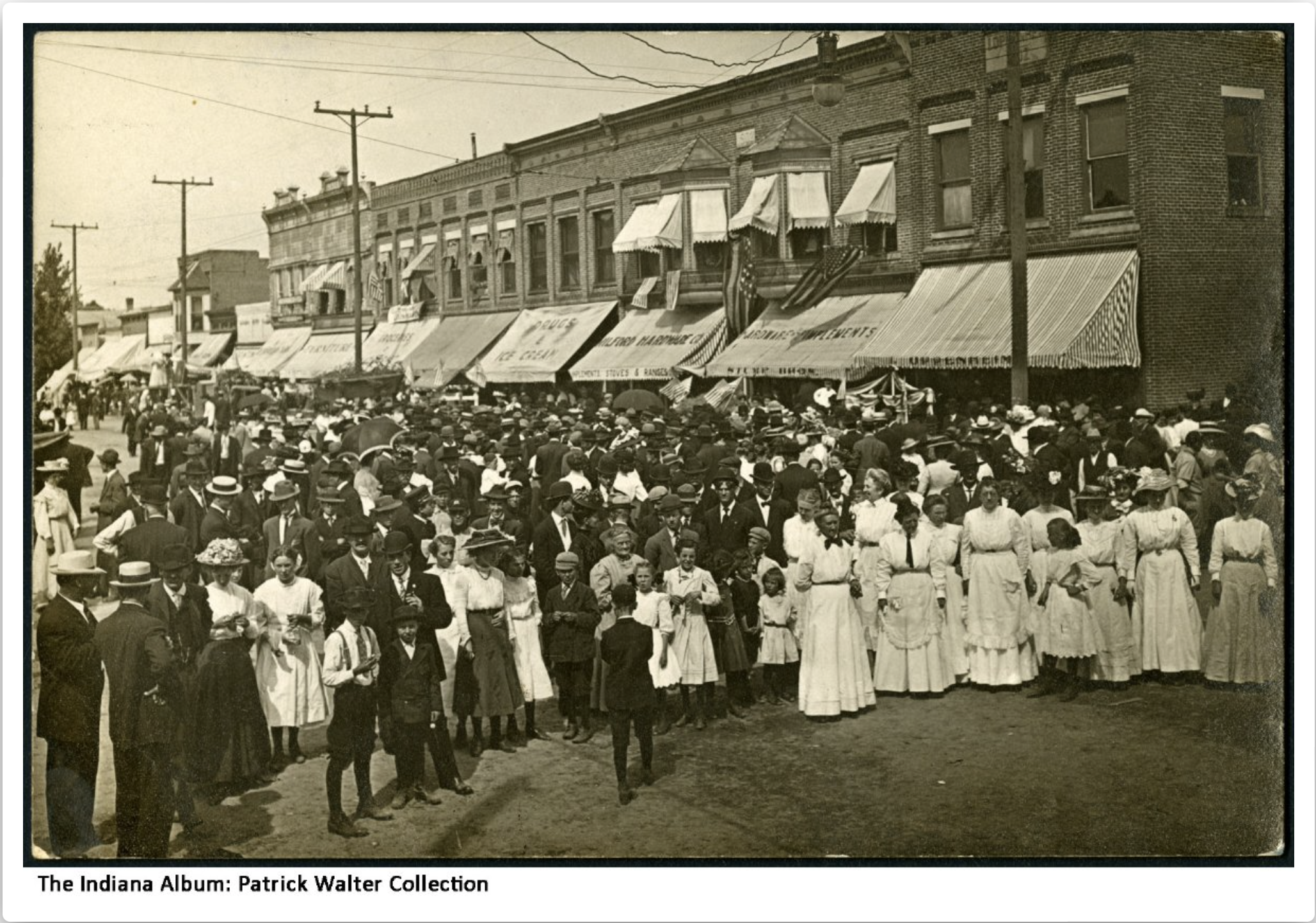
Life changed for the family in 1902 when W. O. and Mary made the decision to leave farming, to move to nearby Milford in Van Buren Township, and to become merchants.  They bought a home on Henry Street in the little town and opened the Milford Hardware Company. The 1910 Census recorded the family now with two sons--Cleon, age 10, and William, age 5.  


This picture, taken in 1910 during the Milford Days celebration, shows the Milford Hardware Store awning behind the crowd.  The awning (third from the right) advertises "Implements, Ranges, Stoves".  I wish I knew if Cleon, William, Mary, and W. O. were in this crowd when the photo was taken.  Or were they in the store, waiting for customers to wander through?

This is an interior shot of the wonderfully crowded and jumbled store.  From the look of it, there was a little of everything a man might need to purchase: horse collars, paint, hand tools, axes, large pots, screws, nuts, nails, you name it.  A store this stuffed must have meant it was a prospering business.     W. O. is the man by the stove wearing the sweater and cap.  Mary isn't seen here but both she and her sons helped out in the store.


The business continued to prosper in the coming years.  By the time the 1920 Census was recorded W. O. and Mary had paid off the mortgage on their South Henry Street home. Life would be good in the hardware business for a few more years.

In 1928 Mary Scott became ill.  It wasn't until she and W. O. went to the Mayo Clinic in the spring of 1929 when the seriousness of her illness was realized.  The diagnosis was a frightening one--carcinoma of the stomach.  At that time there wasn't much that could be done for cancer so Mary and W. O. went home to Milford.  For a while, life went on normally with Mary working occasionally in the hardware store.  In early September of 1929 Mary's condition worsened and she became weaker and weaker and unable to eat until she passed away at home on the 10th of October.
 
October of 1929 would prove to be devastating in another way when the stock market crashed several weeks after Mary's death, paving the way for the Great Depression that followed.  Banks across the country failed, investors lost their savings, unemployment rose, and businesses of all sizes suffered. By 1932 the Milford Hardware Company had closed its doors.  At 63 years old W. O. was a widower and no longer a business owner.  

For a few years W. O. lived alone until one day in late 1935 when he found himself in charge of his four grandsons.  Cleon and his wife Eva had divorced the previous year.  After a year of sole custody Eva wanted to remarry so she left the boys on W. O.'s porch with their clothes in grocery sacks and went off to start a new life.  Cleon was working in Michigan at the time so he hired a housekeeper to take care of W. O. and the boys during the week while he worked.  That was life until May of 1936 when Cleon, the housekeeper, and the boys moved to Dowagiac, Michigan.

Alone again, W. O. served as the Honorary Secretary of the Indiana Implement Dealers association.  In his hardware merchant days he had served many years as the Secretary for the organization.  In the 1940 Census W. O. was still living in on Henry Street in Milford but was listed as a roomer with the Norwood family.  He was recorded as still being employed as Secretary, and said he had worked 60 hours in the previous week.  His salary was $1000/year and he stated that he had income from other sources.  Would that have been income from the Norwood family?  Did he still own the building where the hardware store had been?
from The South Bend Tribune, 4 Feb 1940

In the next few years W. O. began to slow down.  In 1945 he moved to a home in Flora, Indiana run by the Brethren Church after suffering from a cerebral hemorrhage.

                                                from The South Bend Tribune, 21 Dec 1945

Eventually it was hypostatic pneumonia that took W. O.'s life.  Hypostatic pneumonia is a slow-developing pulmonary disorder caused by chronic congestion, blood stasis, and edemas at the bottom of the lungs in persons who are bed-ridden for a long time.

                                                      from The Bremen Enquirer, 4 Jul 1946

located in Salem Cemetery, Milford, Indiana


Sunday, September 3, 2023

Week 36: Tradesman


Every time I look at a picture of my great-grandfather Charles Orastus Bird I can see my dad's face reflected in it.  It's remarkable how much Dad looked like his grandpa.  Even though I don't remember meeting my Great-grandpa Bird, we must have been introduced to each other at a family gathering before he passed away when I was 2 years old.  

Charles "Charlie" O. Bird joined the world on 13 Oct 1874 in Pierceton, Indiana as the fifth of six children born to Albert Arbuckle Bird and Sarah Ann Norris.  Brothers Clarence (1868-1925), Luther (1870-1870), James (1872-1872), and sister Mary (1873-1952) preceded him and brother Stephen (1876-1959) followed him in the family birth order.  The first Census Charlie appeared in was in 1880 when his family lived in Monroe Township, Kosciusko County.  He was recorded as being 6 years old and attending school.  

In March of 1885 when Charlie was 10 his mother died of typhoid fever. I wish I knew if the Bird family stayed together in the years after Sarah's death, but most of the 1890 Federal Census records were destroyed by fire.  Did his father Albert manage to keep the house and farm going with the help of 16-year old Clarence, 11-year old Mary, 10-year old Charlie, and 8-year old Stephen?  Were the younger three sent to live with relatives or did they share the responsibilities with Albert and stay together?  There are so many questions that I'll probably never have answers for.

On 13 Nov 1898 Charlie married Grace Ann Hess in Milford, Indiana when he was 24 and Grace was 18.  Two days earlier Frank Merrick, Charlie's brother-in-law (married to Mary Bird), swore an oath saying that the young couple was of lawful age to be married without parental consent. Interestingly, the county official wrote in a note anyway that Grace's father was consenting to the marriage.


Nine months and twelve days later on 25 Aug 1899 my grandma Eva Mae Bird was born.  By the following summer when the 1900 Census was taken the family of three had moved 144 miles north and east to the village of Britton in Lenawee County, Michigan.  They were living in the same home with Stephen and Elsie Bird and both men were working as saw mill laborers. Charlie's sister Mary, her husband Frank Merrick, daughter Theodora, and Charlie's father Albert had also moved nearby.  Frank was a foreman at the sawmill and 59-year old Albert was working as a laborer there.

Life as a saw mill laborer must not have been agreeable.  A year and a half later, Charlie and Grace had moved back to the town of Milford in Kosciusko County and had become parents again when Ethel Elluria was born in late 1901.  Ethel was followed by Thelma Alberta in 1904, Buenola Bernice in 1906, and Dorothy Lucille in 1908.  In the 1910 Census the family of seven was living in a rented home on Fourth Street in Milford.  Charlie's occupation had changed to painter.  As a painter, his trade would have included preparing walls and other surfaces with fillers such as putty and plaster to repair cracks before applying new paint.  He would have mixed paints, varnishes, and sealants and carefully applied them for a lasting finish.  Besides paint, wall paper was popular so he would have known how to measure and hang the paper over prepared walls. When he wasn't painting indoors Charlie hand-painted billboards and advertisements on the sides of barns along the highway.

                                            Buenola      Ethel       Thelma      Eva       Dorothy                         

In 1914 the first son, Errie Franklin, was born.  But sadly, Errie only lived for two days.  In 1916 Grace gave birth for the last time when son Albert Henry was born, named after both Grace's father Henry Hess and Charlie's father Albert Arbuckle Bird. 

In 1917 at the start of World War I, Congress passed the Selective Service Act authorizing President Wilson to draft men into military service. All men between the ages of 18 and 45 were required to register for the draft.  Men were called to register in three waves; the oldest, born from 1886-1900, were called last.  With a birth date in 1874, Charlie was required to register but was never called into service. The registration recorded him as short and of medium build. 


Somehow the Bird family wasn't recorded in the 1920 Census for Milford but in 1930 55-year old Charlie and 50-year old Grace were living on Higbee Street in a home that they owned. Their 22-year old daughter Dorothy "Babe", 13-year old son Albert "Hank", and 8-year old granddaughter Ruby Sewers lived with them.  Under the column for Charlie's occupation, it said decorator.  The family didn't own a radio and their home was valued at $1800.  Five doors away their oldest daughter Eva, now Mrs. Cleon Scott, lived with her husband and three sons.

In the 1940 Census the Birds were still living on Higbee Street.  At sixty-five, Charlie was still working as a painter/ wall paper hanger.  He had worked just 14 weeks during the previous year, with an income of $450.  His highest grade completed was 6th grade, elementary school.  Only 23-year old Hank still lived at home with his parents.  Family lore is that Charlie enjoyed spending time in a local tavern more than he did working as a painter.  

In 1950 75-year old Charlie was still working as an interior decorator/painter.  He had worked 30 hours in the week before the census enumerator came knocking.  The family home was now at 202 Henry Street in Milford.  

On 2 Jun 1954 Charlie suffered a serious heart attack.  One day later he died in the Elkhart General Hospital, just four months shy of his 80th birthday.  He was buried in the Milford Cemetery where he waited for nine years until Grace joined him.


                           Ethel                           Babe                         Buenola                     Thelma

                                                  Hank                                        Eva

Wednesday, August 23, 2023

Week 35: Disaster


Peggy and Joe c. 1936-1937

In late 1936, before my mom Peggy and her brother Joe were old enough to go to school, the Williams family experienced a disaster one cold winter day.  The farm was located near Osceola, Indiana, on the county line between St. Joseph and Elkhart Counties.  Earlier in the afternoon my grandma and grandpa had worked together spreading chicken manure on their fields. Grandma Irene slowly drove the pickup truck while Grandpa Lester stood in the bed, shoveling out chicken manure.  Five-year old Peggy and four-year old Joe stood on the running boards so they could watch instead of being alone in the house.  When the job was done and everyone was hungry, the family went inside so Grandma could start cooking some dinner.  The water pump on the enclosed back porch had frozen. When Grandpa saw that  he decided to try to thaw it using a gas torch.  That turned out to be a very, very bad idea.  

1930s era farm truck

A similar pump

The walls of the back porch had been insulated with layers of old newspaper which quickly caught fire from the heat of the gas torch.  Grandpa yelled, "Irene, the house is on fire!  Get the kids out!"

Grandma, flustered, hurried from the kitchen with the frying pan holding their dinner and set it outside.  Next she ran for the kids, bundled them up, and led them across the yard to a fence near the barn and told them to put their hands on the fence and not to take them off.  My mom can remember holding on to the fence, crying, and jumping up and down as she and her brother watched the house go up in flames.  Grandma ran into the house several times to get armloads of clothes before the fire made that impossible.

No fire department ever came to help.  Since the farm was situated on the county line, neither St. Joseph nor Elkhart County fire crews claimed responsibility to help.  Grandpa and neighbors did what they could with buckets of water, but they were no match for the flames.  The house was a total loss. 

Grandma's sister Clara and her husband Fred gave Lester, Irene, Peggy, and Joe a temporary place to stay in South Bend while the family decided what to do next.  The decision was to fix up an empty chicken coop on the farm by putting sheet rock on the walls and a covering on the floor.  A wood stove was installed to keep the coop warm and the four Williamses moved into the chicken coop.  Mom doesn't remember how long they lived there but I found a picture labeled "Taken at the Olive Street house in 1937".  The weather looks warm so it was probably the summer after the fire on the farm.  The house fire disaster and life in the chicken coop were in the past.  No one was injured, but bad memories of the fire never left their minds.  


Friday, August 18, 2023

Week 34: Newest Discovery


Stephen Norris
7 Jan 1782 - 11 May 1843

Stephen Norris, one of my 4x great-grandfathers, was born in Warwick, Orange County, New York to Shadrach Norris and his wife Sally McClain Norris.  Until recently I never realized that I had an ancestor who had fought in the War of 1812.  In fact, I don't remember ever reading much more than a paragraph or two about the conflict in any of my history classes so naturally I had to Google it to refresh my memory:

According to the National Archives Research Guide for the War of 1812:

The War of 1812 (1812-15) was fought between the United States and Great Britain, primarily over the impressment of American sailors by the British Navy, as well as disagreements over trade, western expansion, and Native American policy. The war ended inconclusively after three years of fighting. On December 24, 1814, the Treaty of Ghent was signed, officially ending the war.

Stephen served as a sergeant under Captain Abraham Brundage's Riflemen in the New York state militia.  I found a pay stub for three months of his service:


I don't know if the three months were the extent of his service or if this is just one pay stub that survived.  I found that $100 in 1812 was equivalent in purchasing power to about $2,298.43 in today's dollars, making that $25.84 worth $616.79 today. 

I'm glad he was paid since back home he had left his wife Mary Clay Norris in charge of 6-year old William, 4-year old Nathaniel, 3-year old Allen, and infant Henry.  Once his service ended and Stephen was reunited with Mary, the family started to expand.  James was born in 1814; Susannah in 1816; John in 1818; Albert in 1822; Luther (my 3x gg) in 1824; and Stephen Jr. in 1826.  

In 1820 between the births of John and Albert the family migrated from western New York to Holmes County, Ohio.  Twenty-three years later Stephen passed away in Holmes County when he was sixty-one years old.  He and Mary, who died two years later, are buried in the Elliot Cemetery in Millersburg, Holmes County.  


Tuesday, August 15, 2023

Week 33: Strength


                                                                              Lydia 

A portrait of my 2x great-grandmother has hung on my walls for the last 48 years, moving with me from Phoenix to Alhambra to Seattle to Birmingham to Morrison to Littleton to Pueblo to Sandy to Tempe to Auburn to Thousand Oaks to Southlake and, finally, to Denton.  It never feels like I'm officially settled in a home until Lydia and her husband Aaron David Rakestraw are on the wall in their matching oval frames.  I never knew much about her until I did a deep dive this week and realized that the difficult choices she had to make took strength and probably a lot of tears.

                               That's Lydia on the right, currently hanging in my guest room.

Lydia Caroline Moore was born 5 Jul 1841 in Brown County, Ohio.  By May 1850 the Census found her living with her grandparents next door to her parent's home in Boon Township, Madison County, Indiana.  It's confusing why 9-year old Lydia was counted there and recorded as  living with their grandparents, Samuel and Elizabeth Moore.  Next door were Lydia's parents Robert Moore and Jane Still Moore, along with 12-year old Elizabeth, 9-year old Sarah (probably Lydia's twin), 7-year old Margaret, and infant William.  Out of all five children, only Lydia's sister Elizabeth had attended school in the past year.  Grandmother Elizabeth, and parents Robert and Jane weren't able to read or write.

Lydia married Aaron Rakestraw on 15 Feb 1860 in Warren County, Indiana when she was 18 years old and he was 31.  Somehow the couple wasn't counted in the Census that year.  But by the 1870 enumeration Lydia and Aaron had moved to St. Joseph County and had grown their family:

Henry Lincoln Rakestraw  b. 1861–d. before 1870

Levi Albert Rakestraw  b.1863

Angeline Augusta Rakestraw  b. 1865

Oscar Isaiah Rakestraw  b. 1867

Barbara Aldora Rakestraw  b.1869

Julia A. Rakestraw  b. 1870-d. before 1880

In 1875 the County Indexed Land Ownership Map of Liberty Township, St. Joseph County, Indiana showed that Aaron Rakestraw owned 129 acres of land near the northeast corner of the township.  Familiar names on the farms around them are Fryar, Magnus, Whortan, and Geyer. Aaron's sisters all married men with those surnames.  

In 1873 daughter Margaret Melinda was born, followed by daughter Martha Jane (my great-grandmother) in 1876.  That same year 47-year old Aaron died, leaving Lydia with children aged 13, 11, 9, 7, 3, and an infant.  Julia may have died before her father.

What choices did an uneducated, widowed woman with six children have in 1876?  Lydia's own parents had moved from Indiana to Iowa so they weren't around to take her and the children in. Lydia had to be strong enough to make the difficult choice to parcel out most of the children to others who had the means to take care of them.  It must have been heartbreaking to see the family split up but Lydia needed to make sure her children were safe and fed.

By the 1880 Census:
17-year old Levi was working as a farm laborer in nearby Green Township.
14-year old Angeline was working as servant for the Ruple family.
12-year old Oscar was living with the Souder family.  His relationship to Head was "none".
10-year old Barbara was living with her aunt Margaret Rakestraw Fryar.

Margaret Malinda has never shown up in later records so she must have died before 1880.

38-year old Lydia and 4-year old Martha Jane were living in LaPorte County, Indiana.  Lydia was listed on the Census as "housekeeper" for John S. Tyler, a 54-year old farmer.  Martha Jane was listed as "boarder".  It's confusing because on the form Tyler was checked as "married" but there was no wife listed.  Lydia was checked as "widowed".  Was the check mark for Tyler a mistake?  Probably.

Nine years later on 27 May 1889 47-year old Lydia married 65-year old John Tyler. You might think that the marriage would have ended when John died but it was Lydia who preceded him. Lydia was just 53 years old when she died on 12 Feb 1895.  She was buried in Porter Rea Cemetery, now located within Potato Creek State Park in North Liberty, Indiana, next to Aaron and his parents.


I was happy to have found Lydia's grave on 25 Sep 2021 during a trip back to Indiana.  Aaron's grave wasn't marked but there was a base for a headstone next to Lydia's that I suspect is where he was buried. 

I don't know if this article in the South Bend Tribune dated 28 Aug 1874 is about Lydia but I suspect it is since it was published in the "North Liberty News" section of the newspaper.  I wonder what the assault and battery was all about?!?  Was this another example of her strength??


Saturday, August 5, 2023

Week 32: Reunion


Scott Family Reunion 
taken at the home of Joseph and Martha Scott  

I was thrilled five years ago when I received an email from a relative I'd never met.  After taking a DNA test, Ancestry.com identified Brenda as being a 4th-6th cousin of mine so I wrote to her, letting her know my lineage in the Scotts.  She asked if I had a copy of a long-ago Scott family reunion photo--which I didn't--so she sent along not only the above picture but also one that had numbers that identified some of the reunion attendees and a poem that was published about the gathering.  What a lovely gesture!  

According to Brenda, the picture was taken at the home of her great-grandparents, Joseph and Martha Scott.  Joseph was a younger brother of my 2x great-grandfather, Samuel Scott.  Brenda wasn't sure what year the photo had been taken, but she suspected it was around 1915.  I used several clues to narrow down the year it may have been taken. 

1.  The poem mentions: 
"And little Joe who farms for Pa
With Gusta his young wife
Just sailed around mongst older folks
They had their time of life"

Brenda knew that Joseph and Gusta married on 25 Dec 1912 so that gave a starting point since the poem inferred that Joseph and Gusta were still young or even recently married.

2.  The poem was published in the Warsaw, Indiana newspaper in 1915.  Maybe it was the same year or soon after the reunion?

3.  The poem mentioned the time of year:
 "Twas on the 28th of March
And cool and crisp the air 
When friends went out to Joseph Scott's 
And met each other there."

4.  My GrandDad A.C. Scott (#14) looks to be in his early to mid-teens in the picture.  He was born on 10 May 1899.  If the picture was taken on 28 Mar 1913-1915, he'd be either nearly 14, nearly 15, or nearly 16.  To me, he looks to be about 16.  

5.  My grand-uncle Frank Scott (#13) was born 24 Sep 1904.  In the picture he looks like an early adolescent, making 1915 seem much more likely than 1913 or 1914.

Based on those clues, my best guess as to when it was taken is 28 Mar 1915.


#20  William Oldfield Scott, my great-grandfather
#19  Mary Dubbs Scott, my great-grandmother
#14  A. C. Scott, my grandfather, son of William and Mary
#13 William Franklin Scott, my grand-uncle, son of William and Mary
#8 Joseph Scott, reunion host & my 2x great-granduncle
#7 Martha Mickey Scott, Joseph's wife

Joseph Scott (#8) would pass away in 1918, three years after this picture was taken.  He was a Civil War veteran.  His wife Martha (#7) would live until 1926.

My 2x great-grandfather Samuel Scott (one of Joseph's oldest brothers) had died in 1910, a few years before this picture was taken.  His son, William Oldfield Scott, was Joseph's nephew.

I love the patriotic bunting.  This would have been during World War I so that may have been why the porch was decorated this way.  It's interesting to see how every woman is dressed in either a white dress or white blouse and nearly all the men have neckties on.  I wonder about the scarf that Martha Scott was wearing.  She's the only woman wearing anything like it.  Did it or the pin holding it have significance?  I love the enormous hair bows on some of the little girls and the two boys decked out in sailor suits.  In every picture I've ever seen of Mary Dubbs Scott she's facing to the side instead of looking at the camera.  Great-grandma, why did you always do that?


Week 52: Me, Myself, and I

  Dear future family genealogists: I’m writing this to tell you a little about myself—something to help flesh out what online documents migh...