Sunday, March 26, 2023

Week 13: Light a Candle


As I build my family trees it's such a sad moment when I find a relative who died as an infant or toddler.  I try to imagine the grief and loss that the mother must have felt.  In the years covered by my family trees women faced twenty to thirty years of constant pregnancy, childbirth, and nursing with little access to birth control.  Without the use of medical imaging, regular prenatal care, use of antimicrobial agents, and reliable blood transfusions, many babies were stillborn or died within a short time after birth.  Those who were lucky enough to survive infancy faced the hurdle of diseases before the age of vaccinations.  

The child mortality rate in the United States, for children ages five and under, was approximately 460 deaths per 1000 births in 1800.  In other words, for every thousand babies born in 1800, nearly half didn't make it to their fifth birthday.

By 1900, for every 1000 live births, 100 infants died before their first birthday. This statistic was true in the lifetime of my own grandparent.  It makes me wonder how many babies and young children faded into history and didn't make it into the documents that support my research. Here are a few who were recorded:

Mary McKibbon    1812-1812    3rd great-grandaunt

Infant daughter Foulke    1878-1878    1st cousin 2x removed

Bessie D. Foulke    1881-1881    1st cousin 2x removed

Martha Viola Williams    1904-1904 (5 months)    grandaunt

Sally Ann Hess    1815-1816 (15 months)    3rd great-grandaunt

Ezra Hess    1820-1822 (23 months)    3rd great-granduncle

Horatio Hess    1824-1824 (8 months)   3rd great-granduncle

Jacob Hess    1878-1878 (16 days)   great-granduncle

Eerie Franklin Bird    1914-1914 (2 days)    granduncle

Closest to me was my first grandson.  Even with the medical advantages now, unexplained tragedies sometimes happen.  I'll love you forever, Zach, and always wonder about the boy you would have been and the man you would have become.

Zachary Evan Malahowski     27 May 2008    grandson


Tuesday, March 21, 2023

Week 12: Membership


Mary E. Dubbs Scott

My great-grandmother Mary E. (was it Elizabeth?) Dubbs Scott was a woman who had outside interests besides her life as a wife and mother of two.  Mary was born in Union Township, Elkhart County, Indiana on 29 Jun 1868, the daughter of John and Matilda Miller Dubbs.  She was one of six children, the fourth in birth order.  The 1880 Census found the Dubbs family living in neighboring Van Buren Township, Kosciusko County near the town of Milford, where Mary would live for the rest of her life.  At twenty-four she married a Milford man named William Oldfield Scott.  Together they had two sons: my grandfather Angus Cleon Scott and my grand-uncle William Franklin Scott.

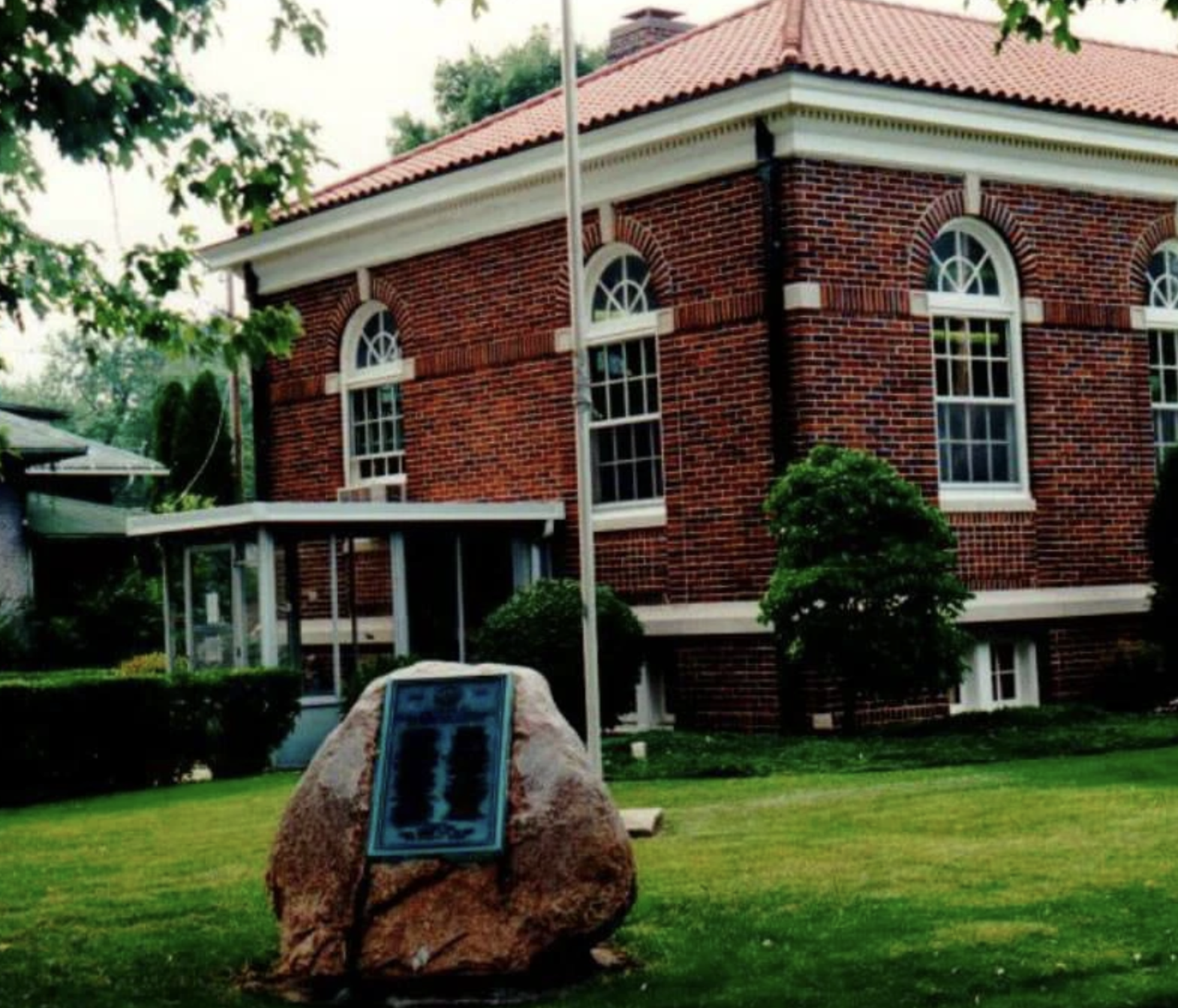
Although Mary was busy keeping house and being a mother, she found time to work in the family hardware store and to be an active member of the Grace Brethren Church's women's group and the Columbian Reading Circle.  I was excited to learn about her involvement with the Reading Circle because I enjoy being a part of two book clubs.  The Columbian Reading Circle members didn't limit themselves to monthly book discussions.  Instead, in 1907 the group spearheaded the formation of the Milford Public Library Association.  They started small in a room of the Hotel Milford with eighty books that were borrowed from the state and organized a community "book shower" to ask for book donations.  In the years following, the library grew out of several temporary homes and in 1916 the library was awarded a $10,000 grant from the Andrew Carnegie Fund.  With the help of that grant and tax funds from the town and townships, a permanent library (which still stands today) was built in 1918.  

Mary passed away from carcinoma of the stomach on 10 Oct 1929, just eighteen days before the stock market crashed.  She didn't live to see the family hardware store fail, to see her grandchildren to grow up, or to meet her great-grandchildren.  But she was loved and she played a part in bringing the gift of a library to the town of Milford.

            Mary and her church women's group.  She is third from left, looking off in the distance!


Saturday, March 11, 2023

Week 11: Lucky


Daniel William Williams was a man who was lucky--or should it be considered unlucky?--in love.  This second great-grandfather of mine was born on 25 May 1851 and lived just two months shy of ninety years.  Why was my first inclination to call him lucky in love?  It's because between the ages of eighteen and his mid-seventies Daniel was able to woo four women to be his wives (two of them were sisters).  No, he wasn't a polygamist.  Daniel was just unlucky enough to outlive three of those wives.

His first wife was a few years older than he.  In the 1870 Census Daniel, age 19, and his bride Nancy Catharine Bullard, age 22, were living with his parents in White County, Indiana.  The young couple had been married two months earlier on 24 May 1870.  Just four months after their vows Nancy gave birth to a son they named Sylvester Wesley Williams.  No record of Catherine's death or her burial has been found, but she died sometime between Sylvester's birth and 1874 since Daniel remarried that year.  Did Catherine die during childbirth, from a disease, or from an accident?  Daniel was unlucky to to be widowed at such a young age.

Before long Daniel was lucky to find a new wife.  On 13 Dec 1874 he married 19-year old Madora Almina Mikesell, my ancestor.  Madora and Daniel quickly expanded their family by adding Eliza May in 1876, Mary Belle in 1877, Owen Quillon (my ancestor) in 1878, Nancy Katherine in 1881, Clyde Monroe in 1885, and Daniel William Williams Jr. in 1886. Including Sylvester Wesley, his son with Catherine, that made seven children.

If most of the 1890 Census records hadn't been destroyed by fire it would have shown that Daniel was unlucky enough to be widowed again the previous year when Madora died on 10 Jan 1889 at the age of thirty-three. On the Find-a-Grave website there is a notation that Madora's grave is shared by an infant named Leonidas who had been born in 1887 and lived for just twenty-one days.  In the same cemetery there is a grave for a child named Leroy Williams who lived from 3 Jan 1869 to 13 Aug 1889.  He too might be Madora's child because she died just a week after this birth.  Daniel was unlucky to have been widowed for a second time.

Being a widower with seven children couldn't have been easy.  Two and a half years after Madora's passing, Daniel was lucky to find another wife, someone he had known for many years. He married Viola "Mandy" Mikesell, Madera's younger sister, on 1 Jun 1891.  When the two married, Daniel was forty years old and Mandy was half his age at just twenty.  Mandy took on the responsibility of raising the seven children from his two previous wives.  

Were Mandy and Daniel lucky enough to have children of their own?  The 1900 Census is confusing because the enumerator recorded the family members still living at home as Daniel, Mandy, Clyde (14) and Daniel Jr. (13).  But it also says that Amanda had given birth to two children who were both living.  Did the enumerator just assume that she was the biological mother of Clyde and Daniel Jr.?  The 1910 Census didn't show any children still living at home. The issue is further confused in the 1920 Census when Daniel and Amanda have a 29-year old son named Joseph Williams living with them plus 33-year old Daniel William Williams Jr.  Both are recorded as step-sons.  Daniel Jr. was Amanda's step-son but who was Joseph?  Was he a biological son who was missed on the 1900 Census?  It's a mystery. 

After thirty-five years of marriage Daniel was unlucky to be a widower again when Mandy passed away from kidney disease in 1926.  But true to form, Daniel was lucky to find a fourth wife, Georgianna Jordan.  He and Georgianna were lucky to be together until 15 Mar 1941 when Daniel died at eighty-nine. Daniel passed away in Illinois but his body was moved to Rensselaer, Indiana to share a headstone with his third wife, Mandy.  

So was Daniel a lucky man or an unlucky man?  He certainly was unlucky to have experienced so many losses in his long life but was lucky to have found the love of four women and lucky to have become a father to eight children who lived past infancy. 


Daniel, Mandy, and 8 children


For some reason, the headstone was never updated to show the last two digits of Daniel's death year.

Tuesday, March 7, 2023

Week 10: Translation


What was it like to come to the English colonies of North America in the 1700's from your native Germany, enduring a rough and possibly dangerous voyage across the Atlantic, and most likely speaking no English?  Who would translate for you?  How would you start a new life on the new continent when you couldn't communicate with most people?

That's what Casper Hess, my 6th great-grandfather, was brave enough to do.  Casper was born in Baden-Württemberg, Germany about 1715 but I don't know what year he made the journey from Germany to the Colonies.  Arrival records are spotty at this time in history and the name Hess was a common one.  The ship lists of immigrants arriving in Philadelphia are incomplete and only males over 16 years of age were recorded.  According to the Pennsylvania German Pioneers book by Strausburger and Hinks:

"Each captain wrote his list on a large, loose sheet of paper which he handed to the magistrate at Philadelphia, who incorporated the names of the signer of the oath of allegiance into the minutes of the council.  What became of the lists of the captains handed in on loose sheets of paper?  Sad to relate, most of them were lost.  Of the 324 ships arriving between 1727 and 1775 we have captain lists for only 138 ships." 

No record of a Casper Hess arriving in Philadelphia has been found.  Does it mean he arrived in another port?  Possibly.  I've seen others post a record on Ancestry.com of a Casper Hess arriving in Carolina in 1743.  But the Carolina colony was a very long distance from York, Pennsylvania where there are records of Casper living and becoming a father.  The surname of Hess is a common one in Germany and I've seen the name of Casper Hess in many time periods and places so I don't think the man who arrived in Carolina was him.

What I do know is that my ancestor Casper Hess married a woman by the name of Maria Eva (maiden name unknown) and together they had a daughter Maria Magdalena in 1745 and a son George Balser in 1747.  Unfortunately, the family didn't have long together because at some point between 1747 when George Balser was born and in 1752 when the widow Maria Eva remarried to Philip Peter, Casper died. He would have been in his 30s at the time. He died intestate (leaving no will) so his death may have been sudden or violent.  It wasn't until 1759, seven years after Maria's marriage to Philip Peter, that an estate was opened for Casper.  The inventory of his estate included some real estate, a house, some household goods, ten books,  a cow, and other items.  The personal property was said to be worth 37 pounds, eight shillings, and four pence more than the value of the real estate.

In his short time in the American colonies Casper was probably a farmer.  He married, had children, and provided for his family, then died a premature death.  What he didn't know was that his son George Balser would someday be a soldier in the American Revolution.  The town of York, Pennsylvania where Casper had lived was a hotbed of activity during the war.  In September of 1777 the Continental Congress moved the location of the colonies' central government to York and it was there where the Congress adopted the Articles of Confederation.  York was the Capital of the United States for nine months until June 27, 1778.  

I'm sure Casper would have been proud to know of his son George Balser's service to the new country.  And I'm sure he would have wondered why it took Maria so long to open his estate.

Friday, February 24, 2023

Week 9: Gone Too Soon


"Gone Too Soon" was a common occurrence in the short life of my great-grandaunt Julia Ann Scott Foulke.  Julia was the daughter of my 2nd great-grandfather Samuel Scott and his first wife, Ann Clinger.  Twenty-two year old Samuel and eighteen year old Ann were married on 18 Jun 1854 in Kosciusko County, Indiana.  Their daughter Julia was welcomed a little over a year later on 2 Sep 1855 but the family of three didn't have long together.  Ann died four months later on 18 Jan 1856, leaving Samuel alone with their infant daughter and Julia without a mother.  What would a young widower do to take care of a daughter and make a living?  I think Samuel's parents Caleb and Mary Scott took over her care while Samuel lived with his uncle Thomas Ivins working as a laborer and continued when Samuel served in the Civil War from 1962-1865.  

In a letter written from the army camp in Murfreesboro, TN, in 1863 Samuel wrote:

"I should like to have you take Julia Ann and get her likeness taken on a plate and send it to me." 

and later in the letter: 

"Well, Julia Ann, I have a nice little watch, that if I get home with it, and you have been a good girl, and learned to spell and read and write good, I will give it to you for a present.  I want you to hurry and learn so's you can write to me."

After Samuel's return from the war he married Nancy Elizabeth Cretcher in 1867 and Julia came to live with them.  By the time of the 1870 census Julia was 15 years old and had a one year old half-brother named William.  Two years later she had a half-brother named Charles.  I like to hope that her years living with her father and step-mother were happy ones for her and that she felt welcomed into the new family.

On 29 May 1877 twenty-one year old Julia married Hugh Aaron Foulke.  In August of the following year Julia gave birth to a baby girl who was either still-born or died the same day. Three years later Julia and Hugh had another baby girl named Bessie.  In another heart-breaking loss, Bessie died after only seven weeks of life.  Less than a year later Julia and Hugh welcomed a son they named Edmond Forrest Foulke.  Julia and Hugh must have been so happy to have this healthy son. 

But the Foulke family didn't have long together to be a family.  Just four years later on 5 Jun 1882 Julia died, leaving her husband and the baby she had waited so long for.  She was gone too soon just like her own mother and both of her infant daughters. 


Thursday, February 23, 2023

Week 8: I Can Identify...


The 1910 U.S. Census entry for my great-grandparents has always been a mystery to me.  Walter and Martha Cartwright had recently moved from their homestead in Mylo, North Dakota, back to northern Indiana.  Their census information contains a puzzle.  Four children are listed; the oldest having been born before the move to North Dakota and three having been born during the homestead years.  The puzzle is that this is the only time the daughter Marie ever shows up on any document or record.  No living family member has any memory of there having been a daughter named Marie.  For a while I wondered if the family's information had been provided by a neighbor and the neighbor was fuzzy on family details but it seems unlikely that someone would imagine a baby. 

 I think the children's recorded ages hold the answer.  Irene (recorded as Irena) was born on 26 Oct 1909.  The census is dated 22 Apr 1910.  The time lapse between those two dates is only 177 days, or 5 months and 27 days.  Irene's age should have been recorded as 6/12 and not 16/12 years.  Could Marie have been adopted?  No, the census says that Martha gave birth to 4 children and 4 are alive.  If Marie was 6/12 years old she would have been a twin to Irene but again, there's no evidence or family lore that Martha ever gave birth to twins.  

My theory is enumerator error.

Sunday, February 12, 2023

Week 7: Outcast


Russell Monroe Williams, my grand-uncle, was the first of eleven children born to my great grandparents Owen and Minnie Williams.  I've never been able to find a photograph of Russell either as a boy or a man but I remember the stories that were told about him.  In the 1910 Census Russell was a 9-year-old boy attending school but by the 1920 Census (dated 29 Jan 1920) he was an 18-year-old who wasn't in school and had no listed occupation.  In September of 1920 Russell joined the Army in Company F of the 49th Infantry and served for eleven months before being honorably discharged on 2 Aug 1921.  

It may have been during this period of service that Russell contracted syphilis.   It was most certainly an unfortunate time to contract the disease.   

Although the cause of syphilis was discovered in 1905--the culprit is a spiral-shaped bacterium called Treponema palladium--there were no effective treatments for it and by the 1930s, approximately 1 out of every 10 Americans suffered from syphilis.  In 1928 Alexander Fleming, a London scientist, discovered penicillin but it wasn't until fifteen years later in 1943 that doctors working at a U.S. Marine Hospital in New York first treated and cured four patients with syphilis by giving them penicillin.

Uncle Russell's syphilis went untreated long enough to cause Meningoencephalitis, a central nervous system infection common in the early stages of untreated syphilis.  Uncle Russell began to show neuropsychiatric signs of mental illness and violent behavior toward his family and in 1941 was admitted to the Logansport State Mental Hospital.  This hospital was his home until 1960 when he died with the official cause of death being Tuberculous Pneumonia. The death certificate listed Central Nervous System Syphilis: Meningoencephalis as a contributing factor.  For the last nineteen years of his life Uncle Russell was only able to see his family under controlled visits at the hospital.  He died alone, never having married.  The family only spoke of him in in hushed tones.

Rest in peace, Uncle Russell.  I'm sorry that a disease made you an outcast and that I never got to meet you.


Week 52: Me, Myself, and I

  Dear future family genealogists: I’m writing this to tell you a little about myself—something to help flesh out what online documents migh...