Tuesday, November 28, 2023

Week 49: Family Recipe

For generations of my Williams family line one of the most loved foods has been homemade noodles.  Noodles could be paired with beef or chicken, but either way they were delicious.  I grew up watching my mom make noodles, just like she had watched her mom and grandma make them.  Once I got married I asked for the recipe, but it turns out there wasn't ever one written down.  Instead, the noodles were made by example, by watching, and by learning just how the dough should feel when it was just right for rolling out.  

Well, I'm  a recipe follower.  I needed more specific directions before I'd try them on my own. So one day as my mom made noodles I wrote down as closely as I could what was happening so once she wasn't there I'd have a record of the process.  It's still not precise, but I do have a starting point.

Meem's Noodles

                            -About 2 cups of flour

                            -4 whole eggs, beaten with a fork

                            Gradually add flour to the eggs until it forms a ball you can handle

                            that's not too sticky.  Place the ball on a floured board or counter and

                            roll out thin.  Let the rolled dough dry for about two hours, then cut

                            it into fourths and stack the pieces.  Slice into pieces about 3" long and

                            however width you want them.  Toss the noodles with more flour and

                            spread out to dry further before cooking in broth.

As a little kid, my favorite way that Mom served them is when she would open a can of beef that my grandpa had given us from one of his cows, mix it with beef broth, and simmer until the beef was tender.  Then it was time to get the mixture to a stronger simmer and to add the noodles a few at a time, stirring to make sure they didn't clump together.  The noodles would absorb some of the beef broth and thicken the mixture a little.  They were best served along with mashed potatoes and a vegetable.  I know, that's a lot of carbs on one plate.  But there was something magical about noodles and beef and mashed potatoes all mooshed together on my plate that made me eat and eat until I couldn't take another bite. 


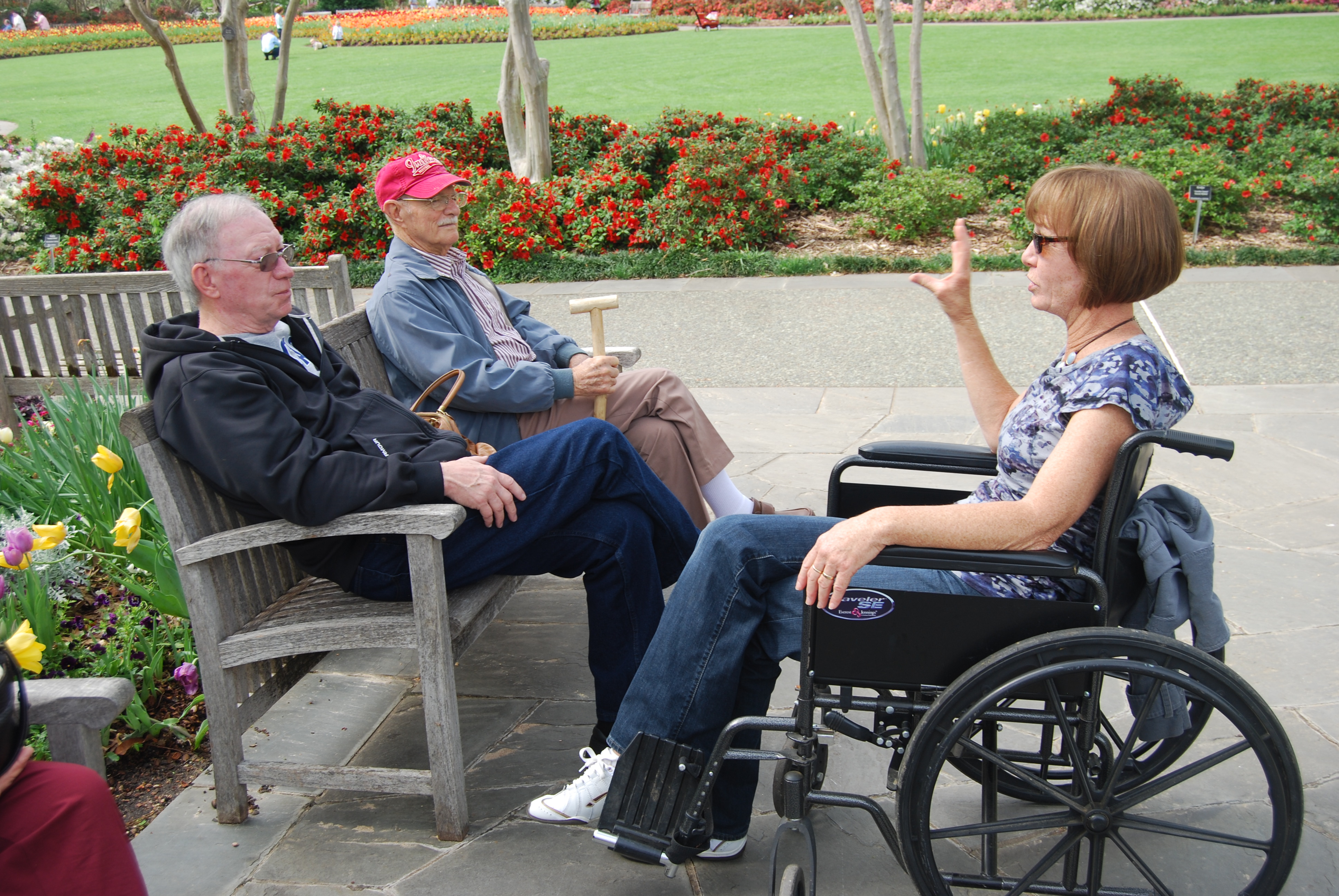
Mom was cleaning up here after noodle making in this shot taken at my house in Texas in 2012.  We had a mini-reunion for Mom with her brothers Bob and Leo; their wives Pat and Bev; my Aunt Kay (widow of Mom's brother Joe); my dad and my sister Janet; and my cousin Bobbie Jo and her husband Jeff.  This day Mom made noodles for us just like Grandma would have.  We had lots of laughs and fun that week hearing the stories that Mom, Bob, and Leo told us about their lives and sharing some of the foods they grew up with.  

Now, just eleven years later, Uncle Bob is gone.  Aunt Bev is gone.  Dad is gone. Aunt Kay is in assisted living.  Uncle Leo is in assisted living, debilitated by lung cancer.  Mom is in assisted living hampered by memory loss.  I'm so glad we had that week together while they were all healthy and able to travel because the memories I have will always be in my heart.  


At the Dallas Arboretum
Bob, Pat, Mom, Janet, Dad, Kay, Leo

Aunt Bev and Uncle Leo

Aunt Pat and Uncle Bob

Aunt Kay, Mom, Aunt Bev

Uncle Leo, Dad, Janet


Tuesday, November 21, 2023

Week 48: Troublemaker


Depression has been a troublemaker in the generations directly before and after mine.  I started wondering how common depression might be in the general population.

From what I can find, it seems that about 1 out every 10 people in the United States will experience major depressive disorder sometime in their life and for some reason, twice as many women as men are affected.  I wondered what part genes might play in causing depression.  

In an article titled "Depression and Genetics" on a Stanford University website, I learned that scientists study patterns of illness in families to estimate what percentage of their cause is due to genes.  One method used is to find pairs of twins to see how common it might be for just one of the pair to have depressive disorder versus both of the pair to be affected.  Studies have found that anxiety and depression are partly hereditary since identical twins (who share 100% of their genes) are more likely to have both disorders when compared to pairs of fraternal twins (who share 50% of their genes).  As of now, no single gene has been identified as the cause.  It may be that combinations of different genes inherited from parents that affect a person's chance of being depressed.  Even if genetics are partly the cause, there are other factors like environment, lifestyle, and personal experiences to be considered.

Whatever the cause, depression is a tough disorder.  In my maternal line alone there have been:

  • three out of four of my mom and her siblings
  • two out of three of me and my siblings
  • three out of three of my children
Luckily for my generation, my offspring, and for some in the previous generation, there have been anti-depressants (selective serotonin reuptake inhibitors or SSRIs) to help. During the 18th and 19th centuries, common treatments were diet changes, enemas, water immersion, and even a spinning stool to put the brain back into a correct position.  In the 20th century, electroconvulsive therapy was sometimes applied to the scalp to induce a seizure as treatment.  Finally, in the 1950s doctors noticed that a tuberculosis medication seemed to be effective in treating some depression patients.  In the 1980s and 90s SSRIs began to be developed.  

There's no way for me to tell from looking at my family tree to tell which of my early ancestors may have had depression disorder, but it must have been immensely difficult to live with those feelings without having effective treatment or understanding of them.   


Saturday, November 18, 2023

Week 47: This Ancestor Stayed Home


At the foot of a massive tree in the Pleasant Grove Cemetery in Warsaw, Indiana, there's a headstone gradually being hidden by its trunk.  My 2x great-granduncle Abraham Scott is buried there.  I've thought about two decisions that he made in his life and have wondered what made him make those choices.  In both cases, he stayed home when others of his family left for the frontier or for war.  What caused him to stay behind?

Abraham was born on 7 Jun 1830 in Lexington Township, Stark County, Ohio, the first born child of  Caleb Scott and his second wife, Mary Ivins.  According to the Biographical and Historical Record of Kosciusko County 1887, Abraham was apprenticed to learn the trades of stonecutting, stonemasonry, and bricklaying when he was 18 years old.  For the next fifteen years he practiced the trade in both Stark and Columbiana Counties in Ohio and was one of the masons who built the first brick building in Alliance, Ohio.

In 1850, just two years after his apprenticeship began, the rest of Abraham's family left Ohio, headed west to the newer state of Indiana.  Abraham said good bye to his 51 year old father and 41 year-old mother. He said good bye to his siblings:  Samuel (18), Emeline (16), William (14), Caleb Shreve (12), Isaac (10), Joseph (8), Mary Jane (7), Joshua (5), Amasa (2), and newborn Nancy Ellen.  It must have been a lonely feeling to see the wagons leave, not knowing if he'd ever see his family again.  Why did he stay?  By the mid-1800s apprenticeships had changed from the formal system followed in England and the American colonies.  Very few young men were bound by formal contracts to live under the rule of the master tradesman and instead were paid for their work as they learned the trade.  Did Abraham love the trade and want to continue learning more about it?   I wonder.

On 28 Oct 1852, 22-year old Abraham married Mary Catherine Hilton Hoils, a widow with three children.  Catherine, as she was known, was four-and-a half years older than he was and had three children by her first husband.  Over the next ten years Abraham and Catherine lived in Stark County and grew their family with three sons--Caleb Frank in 1853, William in 1856, and James Marion in 1862.  Sadly, William died at age 5, just thirteen months before James Marion was born.

In 1862, soon after James was born, Abraham and Catherine left Ohio and followed the road to Kosciusko County, Indiana, where Abraham's family had settled twelve years earlier .  In 1863 he and Catherine purchased 155 acres of heavily timbered land in Washington Township of Kosciusko County near the settlement of Packerton.  Abraham built a rudimentary log cabin (that must have felt strange for a trained mason) and began the work of clearing the land for planting with only a team of oxen. 

During the same two years that Abraham moved and began clearing his new land in Indiana, others men in Indiana were leaving to join the Union army.  Six of his brothers made that decision and headed off to the war.  But 32-year old Abraham chose to stay home in Indiana with his wife and five children.  Four of his brothers who left were young single men; was widowed, with a young daughter; and one was newly married.  Did Abraham feel that he had too many responsibilities at home?  Did he think it was a war for younger men?  I wonder.

Over the course of the rest of his life Abraham transformed his acreage.  The Biographical and Historical Record of Kosciusko County 1887 gave this description of the farm:

"His present farm now consists of 155 acres of well-improved land, and his primitive log cabin and sheds have been replaced by one of the best residences in the county, his barns and outbuildings being correspondingly good."

Abraham and Catherine had two more children after moving to Indiana.  In 1865 daughter Ida May Scott was born and in 1869 son Isaac L. G. Scott was born.  Sadly, in 1872 young James Marion died of typhoid-pneumonia just a few months before his 10th birthday.  In 1879 Abraham and Catherine adopted their 5-year old niece Sarah Frush after Abraham's sister Nancy Ellen Scott Frush died. Abraham would live to see a third son die when Caleb Frank Scott passed away in June of 1898.

Six months later on 10 Dec 1898 Abraham himself died.  In various local newspapers he was described as a prominent farmer; and old and respected citizen; an upright citizen; and a man widely known for his honesty and Christian character.  It was mentioned that he had been ill for two years before his death and that "his death came as a merciful release from the suffering."  He was 68 years, 6 months, and 3 days at his passing.


Thursday, November 16, 2023

Week 46: This Ancestor Went to Market


Mom and Dad in 1973 with their Lake Havasu tans

Why was there no apostrophe???

My dad, Donald Duane Scott, "brought the market" to thousands of customers over the years. Between 1970 and 1989 Dad owned Scotties Catering in Lake Havasu, Arizona, where he drove a mobile food truck that delivered breakfasts, lunches, and dinners to factory and construction workers and employees of small businesses. At first it was just Dad with one truck but over the years other drivers and trucks were added.  

Dad would wake up around 4 a.m. to get the ovens in the back of the trucks lit so they'd be hot when breakfast sandwiches, burritos, burgers, and hot dogs were loaded. The trucks would have been cleaned, restocked, and iced the evening before but in the morning more ice would be added on to refresh the layer covering the sodas and to keep the cold sandwiches that would be loaded cool. Melt-ables like candy bars were brought from cool storage out to the truck shelves.  Relishes were stocked to be ready for the burgers and hot dogs.  Coffee was brewed and poured into the urns. Cigarette stocks were checked.  Then it was time to get armed with the supplies to take the customers' money. Coins were carried in a changer and currency in a canvas belt worn the waist. The previous night the coins and currency had been counted and then a set amount reloaded.  By the time his truck was ready for the road he had worked several hours.


Dad was a well-known and respected figure in Lake Havasu. Before my first summer job of driving one of the trucks I rode along with him on his route for a few days to learn the job. I remember being amazed at how many people in town knew Dad by name, wanted to talk and joke with him when they made a purchase, and considered him a friend. He had a soft heart when someone was short on cash before payday and would extend credit if he knew them. His method for keeping track of charges was to write them on his hand (and sometimes up his arm) in ink so he could transfer it later to paper. Dad loved to trade jokes with his customers and some of his favorites sometimes got a handful of ice thrown at them--trust me, they liked it. For a good portion of the year Lake Havasu is a beastly hot place to work.  His truck had an air horn that blasted an "Ah-Oo-Ga" to let everyone know that Scottie was on the premises.

Scotties Catering was a family affair. My mom was the head cook and kitchen manager, overseeing the making of thousands of sandwiches, hard boiled eggs, and soups over the years. My sister excelled at wrapping hot dogs, driving trucks,  and later at baking banana bread and cookies.  So.  Many. Cookies.  My brother helped clean and service the trucks and occasionally drove a route. During summers after my first three years in college I drove a route.  

Drivers came and went over the 19 years, but Dad was the constant face of Scotties Catering. After several heart attacks it was time to hang up his changer for the last time and enjoy a retired life. Dad sold the business to a nice family who kept the logo so the Scotties trucks still ran for many years.  When Dad passed away in 2014 my sister located one of the Scotties trucks and had it parked outside the church at his funeral.


Tuesday, October 24, 2023

Week 45: War and Peace


Samuel S. Scott

The Civil War was the first war in American history in which a substantial proportion of the adult male population participated. Almost every American would have known friends, family members, or neighbors who marched off to war, many never to return.         --The National Park Service

My 2x great-grandfather, Samuel Scott, was one of the nearly 2.5 million men who volunteered to fight for the preservation of the Union.  Samuel was a widowed father with a 7-year old daughter when he made the decision to leave her with relatives and join the Union Army.  Once he had made the decision, Samuel  traveled to nearby Ft. Wayne on 22 Aug 1862 to join Company B of the Indiana 30th Infantry Regiment.  His rank in was Private, just like his brothers Caleb and Isaac who had joined Company B a year earlier.

According to historian Bell Wiley, who has studied the common Civil War soldier, the average Northerner was “white, native-born, farmer, Protestant, single, between 18 and 29. His height would have been about 5' 8" and would have weighed about 143 pounds.  Most soldiers were between the ages of 18 and 39, with an average age of 26.”  Samuel checked most of those boxes.  He was a white Protestant farmer who was single, but not by choice.  I wish I knew his height and weight but I'm clueless as to either of them.  Union soldiers initially earned $11 a month but in June 1864 the Union raised the soldiers' monthly wage to $16.

On 5 Apr 1863 Samuel wrote a letter home to his parents Caleb and Mary Scott from the Hospital Department of the 2nd Battalion, Pioneer Brigade, Army of the Cumberland in Murfreesboro, TN.  The letter doesn't say he was there because of wounds but it's likely that he had been wounded fighting with the 30th Indiana at the Battle of Stones River, which took place between 30 Dec 1862 and 3 Jan 1863 in Murfreesboro.  In that battle the Union army lost 1,700 men who were killed, 7,800 who were wounded and 3,700 who were missing or captured--a total of 13,200 casualties from an army estimated to count 41,400 in the battle that took place there. 

From his words, it's easy to tell that he's lonely for everyone back home:

Respected parents I find mi self out more seated with pen and ink tring to scribe a fu lins to let you no that I am well at present and hop that ma find you the sam.  I hav not had any letrs from you for mor than a month what is the reson I cant tel I am geten tird of riting and not getting one ansers from you but anuf of this I am seting up with the sick and riting betwen spels and if I mak som blundrs you ma just pas them bi for what that wil fetch for I hav run out of nut to rit.

Samuel's handwriting was beautiful, but his spelling was weak.  Here’s an edited version by my cousin John Scott, who discovered the letter in the Indiana State Library:

Respected parents, I find myself out more, seated with pen and ink, trying to scribble a few lines to let you know that I am well at present and hope that I may find you the same.  I have not had any letters from you for more than a month.  What is the reason, I can't tell.  I am getting tired of writing and not getting one answer from you.  But enough of this.  I am setting up with the sick, and writing between spells, and if I make some blunders, you may just pass them by, for what they will fetch, for I have run out of news to write.

A portion of the letter home

Samuel mustered out of the 30th Indiana on 29 Jul 1864 and transferred into the 1st Regiment, Company C, of the U.S. Veteran Volunteer Engineers.  This regiment was organized in the Dept. of the Cumberland from the Pioneer Brigade.  Duty with the Veteran Volunteers Engineers consisted of repairing railroads, building block houses and bridges, destroying and building transportation networks, erecting defensive and offensive emplacements, providing situational intelligence, and general engineering duties.  Samuel mustered out of the VVE on 26 Jun 1865 holding the rank of Artificer (skilled craftsman) and headed back home to Indiana when the war ended.

He was 33 years old by then and luckier than thousands of his fellow Union soldiers.  Of his five brothers who also joined the cause, only Caleb didn't return home.  Many families weren't as fortunate. Samuel must have been so happy to be reunited with his 10-year old daughter Julia and to begin a peaceful life away from the war.  

On 12 Nov 1867 Samuel married Nancy Elizabeth "Lizzie" Cretcher.  At just 23 years old, she was twelve years younger than Samuel, but the family of three set up housekeeping.  Samuel bought 70 acres of land in Section 16 of Harrison County the next year.  The skills Samuel learned in the Veteran Volunteer Engineers must have transferred to his civilian life because in the 1870 census his occupation was listed as "carpenter".  The family home might have been a modest one at first but this picture shows a large home with the front section of made of brick.  The inscription on the back says the brick home was built in 1888 so maybe it was added on to an earlier structure. 
 
The Samuel Scott farmhouse


 In 1869 the family expanded with the birth of my great-grandfather William Oldfield Scott and again in 1872 when my great-granduncle Charles Neil Scott was born. Julia left home to be married in 1877. 

Samuel must have been a man who planned ahead.  In December of 1901 he wrote his will, naming Lizzie as the intended recipient of "all my personal property, household goods and kitchen furniture, and all property of a personal character which I may have at the time of my death", along with "the use, rents, profits, occupancy and control of all my real estate of which I may die seized".  

Nine years later, on 18 Dec 1910, Samuel passed away from chronic bronchitis and atheroma (degeneration of the arterial walls) a few weeks shy of his 79th birthday.  He had endured the loss of his first wife, Ann Clinger, only a year and a half after they were married; years of separation from his daughter Julia; the loss of his brother Caleb during the war; and Julia's death in 1886.  He had outlived eight of his eleven siblings and both his parents.  
 
Resting in Union Cemetery, Warsaw, IN


I love old obituaries--the multiple headlines always make me smile.  By the time you've read them, you already know the gist of the article.


Friday, October 20, 2023

Week 44: Spirits


Pleasant Grove/Bates Cemetery near Warsaw, Indiana

On a beautiful Fall day in September of 2021 I visited three old cemeteries on rural roads in northern Indiana.  During my genealogy research I had found that many of my Scott ancestors were buried in three cemeteries in Kosciusko County so I made a list of the known ancestors in each, my relationship to them, and mapped out the directions.  All the cemeteries were on quiet country roads surrounded by farms and corn fields and cemeteries are one of my favorite places to visit. I enjoy imagining the lives those spirits must have lived.  What were the joys they felt?  What tears did they shed?  What decisions did they make?  Who did they love?  What were the hardships they faced?  

To some it might seem morbid to walk among the weathered tombstones but I think their spirits know I'm there.  I like to think it makes them happy that they're thought about by a descendant. Some graves had crumbling headstones that seemed to say those spirits were forgotten.  I wanted my Scott kin to know that I was there and that I think about them and comb old records for clues about their lives.  I think about all the questions I'd ask them if we ever had the chance to meet.  

The spirits I visited in the Pleasant Grove Cemetery:
3x great-grandfather and great-grandmother Caleb Scott and Mary (Ivins) Scott
2x great-granduncles Abraham, Isaac, Joshua, Amara, and William
2x great-grandaunts Mary Jane and Nancy Ellen
Most of the great-granduncles and aunts also had spouses and children buried there.

The spirits I visited in Union Cemetery:
2x great-grandfather Samuel Scott and great-grandmother Lizzie (Cretcher) Scott
Samuel's first wife, Ann (Clinger) Scott
Samuel and Ann's daughter Julia Ann

The spirits I visited in Oakwood Cemetery:
2x great-granduncle Joseph Scott
2x great-grandaunt Emeline                                                           
Spouses and some children were also buried here.

The only two of Caleb and Mary's children who aren't buried in Kosciusko County are Thomas Edward who died as an infant before the family moved from Ohio to Indiana and Caleb Shreve Scott who died in a Confederate prison hospital.

Caleb, Mary, Samuel, and Lizzie~ know that your descendants are doing well.  Several of my cousins and I do family research to make sure those who come after us will know about you.  Your memory will live on.

From a poem by an unknown poet: 

You did not know that I exist;
You died and I was born.
Yet each of us are cells of you
in flesh, in blood, in bone.
Our blood contracts and beat sa pulse
entirely not our own.
Dear Ancestor, the place you filled
so many years ago
spreads out among the ones you left
who would have loved you so.
I wonder if you lived and loved,
I wonder if you knew
that someday I would find this spot
and come to visit you.


Thursday, October 19, 2023

Week 43: Dig a Little Deeper


A few months ago I found an email in my inbox from FamilySearch.org, the genealogical website of the Mormon Church, with this interesting statement.  Really?  According to their massive world-wide family tree, Pocahontas is my 12th great-grandaunt.  I'm descended from her sister, Matachanna.  That many generations of distance must have diluted any traces of Native American blood since none showed up in my DNA testing but it was interesting to see the family tree generations that connected me to Pocahontas.

All I knew about Pocahontas is the little I learned in grade school.  As I remembered the story, she was an Indian princess who fell in love with the Englishman John Smith and begged her father to save his life when he was about to be executed.  As it turns out, that was a legend according to historians who have researched and studied that time in history.

Pocahontas was born around 1596 in what is now the Tidewater area of Virginia.  Her father Powhatan was the paramount chief of an alliance of 30 Algonquin-speaking tribes and her mother Winganuske was his first wife.  Pocahontas was given the name Matoax at birth but that name was concealed from the English out of a belief that if her real name was known, they could hurt her in some way.  

John Smith arrived in present day Virginia in a group of 100 settlers in April of 1607.  Eleven-year old Pocahontas first saw John Smith when he was captured by her uncle Opechancanough and brought to Chief Powhatan. What happened next--as Smith told it years later--was that he was placed on the ground with his head on a rock as a warrior stood ready to bash his head with a club.  Before this could happen, Smith said, Pocahontas rushed to him and placed her head on his, stopping the messy execution.  

Historians, on the other hand, doubt that this ever happened.  When John Smith first wrote about his capture in 1608 he didn't mention any threat to his life.  In fact, he wrote about a feast and a meeting and never mentioned Pocahontas.  It wasn't until 1616 in a letter he wrote to the Queen of Denmark that he told the tale of his near-death experience and rescue.

After Smith returned to Jamestown, Chief Powhatan sent food to the starving English on several occasions.  Pocahontas usually accompanied the food deliveries as a sign of peace to the English.  Friendly relations began to deteriorate in the winter of 1608-1609 after a drought the previous summer had greatly reduced the native's corn crop, leaving them little food to share with the English.  The settlers demanded more food and began to threaten the tribes.  Over the next few years, the relationship deteriorated.

English accounts between 1610 and 1613 don't mention Pocahontas.  But in 1613 a Captain Samuel Argall decided that capturing her would give him leverage to improve the English position.  With the help of native American Iopassus and his wife, a plan was hatched. Iopassus and his wife asked Pocahontas to accompany them to see Captain Argall's ship where they convinced her to go onboard to accompany Iopassus's wife.  Once onboard, Argall refused to let Pocahontas leave and declared that she was being held as ransom for the return of English prisoners and weapons held by her father.

Pocahontas was brought to Jamestown and put under the charge of a minister where she was schooled in the English language, religion, and customs. She was baptized and renamed Rebecca.  During the time she being schooled she met and fell in love with an English tobacco planter named John Rolfe.  In April of 1614 she and John Rolfe married and relations between the English and the natives calmed in a period sometimes called "The Peace of Pocahontas".  Soon after she and Rolfe had a son they named Thomas.

The Virginia Company of London, who had funded the settlement of Jamestown, decided to send Rolfe and Pocahontas to England.  The thought was that the young Christian convert who had married an Englishman could encourage interest and investment in the Virginia settlement.  The Virginia Company paid all expenses for the Rolfes to travel to England, even allowing about a dozen Powhatan men and women to accompany them.  In England, Pocahontas was referred to as Lady Rebecca Rolfe as they toured the country.

In March of 1617 when the Rolfe party was set to return back to Virginia, Pocahontas became seriously ill as they sailed on the Thames.  After being taken off the ship she died in a short time.  Historians aren't sure what illness took her but some theories are pneumonia and dysentary.  Pocahontas, who was just about 21-years old, was buried in England at St. George's Church on 21 Mar 1617.  John Rolfe returned to Virginia alone, leaving his young son with relatives and his young wife in her grave.

A year later Pocahontas's father Powhatan died.  Relationships between the English and the natives deteriorated and the "Peace of Pocahontas" was over.

The real story had none of the songs or romance of the Disney movie.

                                        A depiction of what Pocahontas may have looked like 

An image of Lady Rebecca Rolfe done during her time in England

                                                    A romanticized depiction of the legend


Week 52: Me, Myself, and I

  Dear future family genealogists: I’m writing this to tell you a little about myself—something to help flesh out what online documents migh...